
Pilonidal Sinus Surgery: Modified Karydakis Flap
Among the most effective closed techniques for treating pilonidal disease is the modified Karydakis Flap (or “Bascom Cleft Lift”).
Modified Flap Karydakis Operation
Pilonidal cyst is an infectious process that occurs in the cleft of the intergluteal groove, which is usually treated surgically, accompanied by antibiotic therapy. Among the closed techniques to treat pilonidal disease is the modified Karydakis Flap, also known as Bascom Cleft Lift.
This technique can be performed with an overnight stay or on an outpatient basis, with excellent results in healing, complications and recurrences; it is therefore one of the best options in the management of most cases of pilonidal sinus. Closed techniques have advantages over open techniques, due to the prolonged healing period, with the need for daily dressings for months in the latter.

What is the Flap Karydakis technique?
Treatment of Pionidal Sinus with the Flap Karydakis technique is particularly recommended, because it is a simple and reproducible procedure, which leaves a relatively small scar, and with a very low recurrence rate (less than 4%).
Like most pilonidal surgeries, the Karydakis Flap Operation in Madrid can be performed on an outpatient basis with no hospitalization required, although an overnight stay is often recommended.
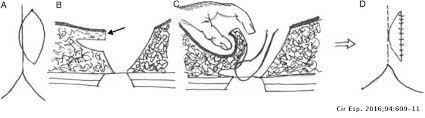
This technique is characterized by the design of an oval whose axis is lateralized from the midline and includes the fistulous orifices, thus moving the scar away from the midline.
Once resection and hemostasis have been performed, the wound is closed, trying at all times to flatten the intergluteal sulcus.
Drainage
In most cases, a drain will be placed, one of the most commonly used in surgery, which is a multiperforated rigid plastic tube.
This tube is connected to a vacuum canister, which produces the suction of hematic debris, serous fluid or possible infections of the surgical wound.
This drain is removed several days after surgery, depending on the amount of fluid it is suctioning; while stitches are usually removed about two weeks after surgery.
Shaving
In certain cases, in the area affected by pilonidal disease it may be useful to minimize the amount of hair, which could be trapped in the pores of the midline. In any case, it will be in the operating room where they will decide if and to what extent shaving is necessary.
On the other hand, after surgery, hair removal is also unnecessary because the cleft flattens and avoids the need for any type of waxing or shaving.
Because of all this, we do not recommend shaving or waxing from the lower back to the buttocks, mainly to avoid recurrence of pilonidal disease. In any case, for patients who wish to undergo laser hair removal anyway, we recommend waiting 8 to 10 weeks after surgery.
ADVANTAGES
After removal of the pilonidal sinus, the tissue is reshaped using plasty techniques, creating a shallower intergluteal fold, and the suture line of the primary closure is moved out of the midline.
By modifying the local conditions of the intergluteal fold and reducing the tension on the sutures, a lower incidence of surgical wound dehiscence is achieved, as well as greater postoperative comfort by reducing postoperative pain secondary to stitch tension and by avoiding the discomfort associated with prolonged healing of an open wound.
All this favors a more accelerated recovery, with an earlier return to normal activities and a superior cosmetic result. In the long term there seems to be a lower propensity to recurrence of the pathology.
This is a more complex surgical technique than the one usually practiced (en bloc excision with or without primary closure) and requires specific training, experience and a significantly longer surgical time.
It is effective
Ideal surgical solution for the treatment of pilonidal cysts and abscesses, due to its effectiveness in healing the infected area.
Easy postoperative period
Postoperative care is easy, which includes cleaning and disinfection of the open wound, ensuring that it heals without problems.
Painless
The procedure is painless, thanks to the local anesthesia applied.
Care before and after surgery
Before the modified Flap Karydakis surgery in Madrid, it is recommended to the patient:
- Fast for at least six hours before surgery.
- Eat a balanced diet, rich in proteins, fiber and liquids.
- Do not shave the affected area either before or after surgery, as this increases wound infection rates (this will be taken care of by the medical staff).
- Take precautions not to travel or move around a lot on the day of surgery and even a few days after. For this reason, it is recommended to rest.
Among the postoperative care of the modified Flap Karydakis surgery in Madrid, the following stand out:
- Adopt the supine position (lying on your back) after surgery. Do not spend a long time sitting down.
- Use compressive bandage in the first postoperative hours.
- Keeping overweight or obesity under control, an important factor in the probability of recurrence of pilonidal cysts
- Eat a balanced diet, rich in proteins, fiber and liquids.
- Maintain hygiene and care of the area
- Attend the revisions for removal of stitches on the date indicated in the discharge report.
- Avoid intense physical activity or activity that exposes the wound to direct blows one month after surgery (mainly cycling or horseback riding).
- To remain under permanent and specialized medical supervision until final medical discharge.
Frequently Asked Questions
about Pilonidal Sinus
- Reddening of the skin
- Pain
- Presence of pus or blood in an opening of the skin.
- Unpleasant odor of oozing pus.
This pathology should be treated by a specialist in coloproctology, which is responsible for the diagnosis and treatment of diseases of the colon, rectum and anus.
As we know, the pilonidal cyst is located in the region above the intergluteal fold, an area of treatment for this specialist.


